
Littleton City Directory Collections
Littleton’s historical shelf is a set of dated sources, not one continuous roll. The official Littleton citywide historic survey identifies Winterbourne’s Littleton City Directory from 1905, the XL Directory of Western Arapahoe County from 1932, Denver Suburban Directories Section E from 1939, and later Littleton editions.
| Collection | Years | Where Held | Access |
|---|---|---|---|
| Winterbourne Littleton City Directory | 1905 | Historic survey; verify local copies through Bemis and Columbine | Survey citation; library or society request |
| XL Directory of Western Arapahoe County | 1932 | Historic survey; DPL, Bemis, or Columbine finding aids | In person or copy request; compare transfer records |
| Denver Suburban Directories, Section E | 1939 | Historic survey; DPL regional directory index | Sectioned search; verify the Littleton label |
| Littleton City Clerk directories | 1953, 1955, 1957, 1959, 1961, 1962 | Colorado State Archives finding aid and city-clerk series | Reading/reference service; archive email or mail |
| Later Littleton editions located by the survey | 1965, 1974, 1976, 1985 | Survey bibliography; DPL, Bemis, and Columbine access paths | Holdings vary; ask for edition, copy, or ILL route |
This is a located-year list, not proof that every intervening edition survives or has been digitized. The survey describes directories available for 1932-1974 and some years into the 1990s, while the State Archives finding aid specifically lists the 1953-1962 city-clerk series. DPL organizes holdings by municipality, county, and year, but a regional search hit still needs a check of its section.
Access follows the holder. Bemis and Columbine are practical local paths, the State Archives supplies archival reference, DPL supplies index and digitized routes, and the Museum and History Colorado add context or microfilm leads. Library copy or interlibrary-loan requests, society research or copy requests, and archive email or mail can bridge a missing scan. A Littleton CORA request applies only to historical files held by the city.
Reading a Littleton City Directory Entry
A Littleton city directory entry needs a citation before interpretation. Record the edition year, page or section, exact spelling, and the arrangement used. A name may appear in a household list, an alphabetical householder index, a street-order or criss-cross section, or a business listing. Initials, spouse forms, and changed street names can hide a match.
| Name | Printed surname and given name; spouse, widow, or initial forms may differ |
|---|---|
| Occupation or business | The role or business label as printed; a directory clue, not proof of residence |
| Address | House number and street when supplied; older entries may be unnumbered or use a place name |
| Telephone | Number if present; its absence does not settle where a person lived |
| Household context | Spouse, boarder, family, or business context when the edition supplies it |
| Owner or renter mark | Interpret an r, h, or other mark only after checking that edition’s legend |
- Criss-cross directory
- A reverse, street-order section that moves from an address to a named household or business. It does not establish title.
- Householder index
- A name-order section that points to a listed address or entry. Use it as a finding aid, then inspect the full citation.
- Abbreviation key
- The volume’s legend for marks and shortened terms. Read it before treating an
rorhas a fact.
A directory is a dated clue, not a current resident register. A boarder may appear without owning a building, a business may occupy a property without showing who lived there, and a mailing address may differ from a home. Compare adjacent editions and likely name variants before drawing a family or house-history conclusion.
Littleton’s 1905, 1932, and 1939 City Directories
Winterbourne’s 1905 Littleton City Directory is the earliest located run with specific street addresses. Earlier material can list a business without a street number, and one residents section uses “Windermere” without an address. A blank name search therefore cannot prove that a household was absent.
The 1932 XL Directory of Western Arapahoe County is an early ownership clue, but its county scope matters. The 1939 Denver Suburban Directories, Section E, is a regional section, not automatically an all-city Littleton volume. Compare both with the historic survey, transfer or recorder references, and the exact edition label. Business entries can add local texture, but they remain dated uses rather than a continuous occupant chain.
Littleton City Directory Editions, 1953 to 1985
The later runs are best treated as dated checkpoints rather than an uninterrupted series. The located Littleton editions are listed below, with the State Archives city-clerk set covering 1953-1962.
- 1905 Winterbourne’s volume, the earliest located edition with specific addresses.
- 1932 The Western Arapahoe County volume supplies an early regional ownership clue.
- 1939 Denver Suburban Directories Section E preserves a regional comparison point.
- 1953-1962 State Archives city-clerk directories are located for 1953, 1955, 1957, 1959, 1961, and 1962.
- 1965-1985 The survey locates editions for 1965, 1974, 1976, and 1985.
Gaps in the 1910s, 1920s, and early 1940s are part of the record picture. Rural addresses may not appear, and some years may be held without a public scan. DPL, Bemis, Columbine, and State Archives staff can confirm whether a requested year is present and whether copying or reading-room access is available.
Finding Littleton’s Directory Shelf
Bemis Public Library is both a local-history clue and a practical research stop. Its history records an 1892 train-wreck fire that destroyed an earlier library collection, a $200 Santa Fe gift, and a replacement library in the Gilbert and Martin drugstore. By March 5, 1897, that library held about 275 books. A 1906 dog-tax appropriation helped support library work, followed by an $8,000 Carnegie grant and a building opened in August 1917. The present Bemis Library at 6014 S Datura St was dedicated in October 1965 and expanded in 1982. The listed phone is 303-795-3961, with Monday-Thursday hours of 9-8, Friday and Saturday 9-5, and Sunday 1-5. Confirm current hours through the Bemis history page.
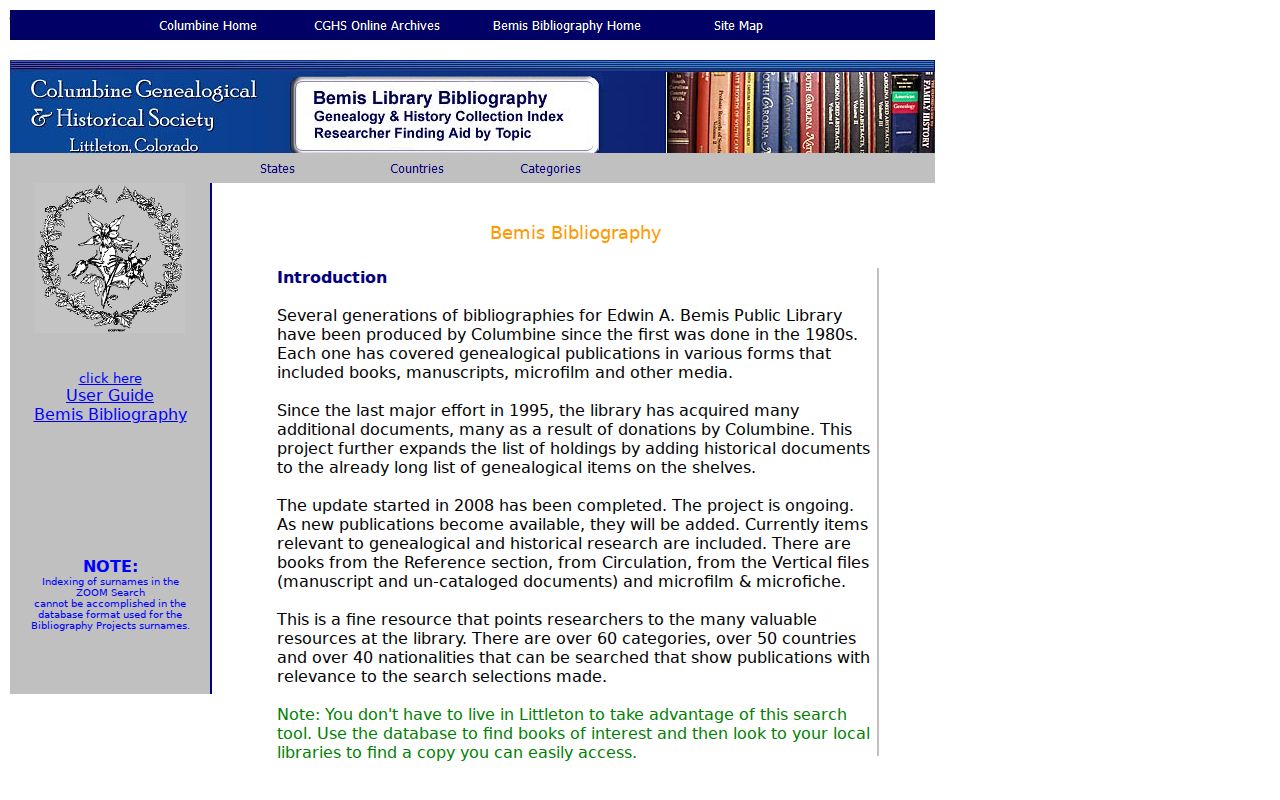
The Bemis catalog is the first search for local books, microforms, biographies, histories, and genealogy materials. The Columbine Society’s local resources approach half a million records, and its bibliography spans books, microfilm or fiche, videos, CD-ROMs, and vertical files across more than 60 subject categories.
The Columbine bibliography gives a visual starting point for those subject headings and local-history leads.
A missing volume can still be pursued through the DPL Colorado directories index, its digitized directory search, the Littleton Museum chronology, History Colorado microfilm references, a library copy or interlibrary-loan request, a society copy or research request, or State Archives email or mail. Those routes are more reliable than treating an absent scan as a destroyed record.
The 1961 Littleton Address Conversion
The historic survey gives a critical cross-reference: the 1961 metropolitan grid changed 144 N Lincoln Ave to 5652 S Spotswood St. Search the old number, new number, old street name, new street name, block, and nearby landmark. Some addresses remain absent even after the conversion, so a failed modern search is not a final answer.
Current assessor ownership, Clerk and Recorder transfer books, and historic appraisal cards are separate sources. The survey says appraisal cards were being scanned or were inaccessible in its research context. Once an old and new address are paired, the current address chain belongs with the Littleton street directory, while the historical volume remains the evidence for the dated entry.
Note: A directory entry on one side of the 1961 conversion is a clue to a place and time, not proof of an unbroken ownership history.
Littleton City Directory Leads from Newspapers
Directory gaps are often narrowed by local indexes. The digitized Littleton Courier contains 1900-1909 and 4,279 pages. The Littleton Independent obituary index is partial: the newspaper began as the Littleton Gazette in 1888, and the index includes scattered 12/6/1895-3/16/1923 coverage plus a 9/17/1970-4/5/1973 run. Maiden names appear in parentheses, and duplicate or bracketed entries matter. The latest index version is September 2017.
Colorado Historic Newspapers can fill some date gaps. Microfilm for the Independent is identified at the Littleton Historical Museum, Denver Public Library, and History Colorado. Bemis librarians can supply copies through the Society’s stated $20 copy or research route, subject to current terms.
- The Arapahoe marriage extraction covers 1940-1965, with 37,746 names in three volumes.
- The Littleton Cemetery index covers 1869-1981 and reports 8,202 records with plot and relative clues.
- The Nickels-Hill-Drinkwine mortuary index covers 1915-1950, seven microfilmed books, and more than 2,000 names.
- Church sources include Littleton Methodist, St. Paul, St. Timothy, and First Presbyterian runs.
These indexes point toward a source; they do not replace the newspaper, ledger, church volume, or archive citation. The Colorado Secretary of State business search is for current filings only, not proof of a historical directory entry.
Littleton City Directories with Sanborn Maps
The Library of Congress 1893 Littleton Sanborn map has two sheets. It supplies building footprints, street names, business uses, and block context. It is map context only, not a title record, occupant list, or proof of a later address.
Pair the map with the citywide survey and a dated building survey. The 2559 W Main St survey transcriptions, for example, mention Clyde A. Rice at 211 W Main in 1932, James R. Porter at 215 W Main, Nu Way Cleaners and Dyers with Ralph McLean, and Heckethorn Manufacturing and Supply with W.W. Heckethorn in 1939. Verify the full survey PDF and do not turn a business reference into a continuous household claim.
When an old entry needs a present-day identity check, use the Littleton resident lookup and the relevant custodian records. A directory, map, parcel record, and resident result answer different questions.
Tracing a Littleton Household Across Years
A household search works best when each volume is treated as a dated checkpoint. Keep the source year and page with every name, then pair the nearest directory evidence with a released federal census checkpoint. The National Archives census guide explains the 72-year release rule, and the public 1950 Census provides a useful comparison point when the date fits.
- Start with the name spelling, likely municipality or county, and the earliest plausible directory run.
- Record the exact address, household context, occupation or business label, telephone, and any unexplained mark.
- Check adjacent editions, spouse or initial variants, and both sides of the 1961 street conversion.
- Pair the dated entry with the nearest federal census checkpoint to test household size and place at that time.
- Close a gap with the obituary, cemetery, church, mortuary, newspaper, or archive route that matches the person and date.
If a name disappears, possible explanations include a move, death, a rural or unnumbered address, a missing edition, or a change in how the volume indexed the household. The partial obituary index, cemetery ledger, church books, and newspapers can help separate those possibilities.
Littleton’s civic history helps date the shelf. The town plat was filed in 1872, rail connections arrived in 1871 and 1887-1888, and incorporation came in 1890 at a population of 245. After Arapahoe County was divided in 1902, the 1904 county-seat election defeated Englewood 1,310-829, making Littleton permanent county seat. The city reached 48,140 people in 2020, but population totals are context, not proof about a directory entry.
Research limit. No complete public image of a Littleton city-directory page was found in the official sources reviewed. Use the survey bibliography, Bemis, Columbine, DPL, State Archives, and in-person reference channels rather than substituting an unrelated scan.